CORBETT x FLUXSPACE x DSS - Proof Of Concept
13 scenarios · One learning environment
13 interactive scenarios for the modern K-12 learning experience — each built end-to-end with real Fluxspace, Corbett and DSS products. Scroll to walk through each scene, then dive into the systems behind it.

Emotional kickoff + public showcase stage.
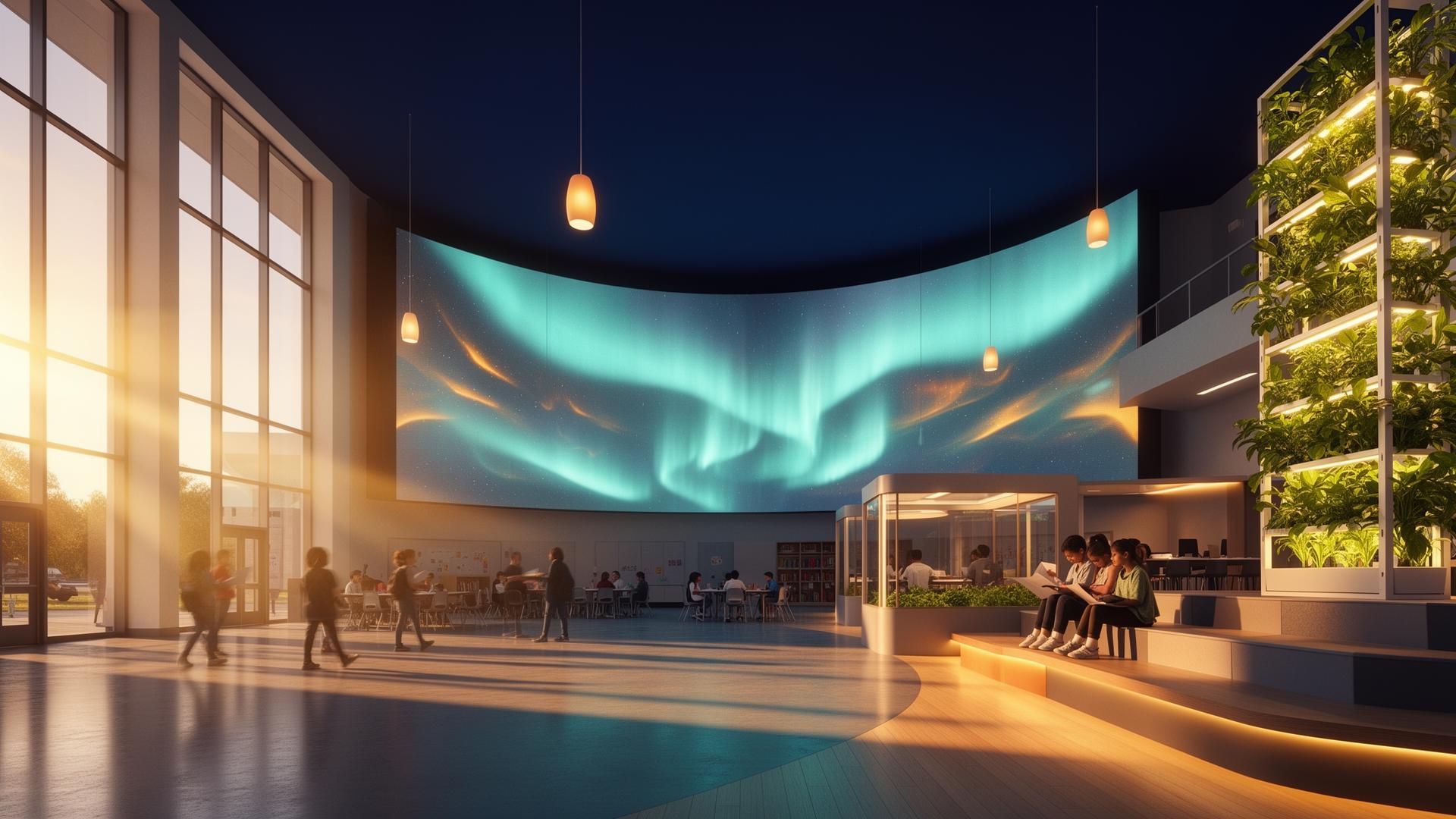
A story-driven first step into the school day.
Walk-through · what the space feels like
The doors open into a double-height commons that feels less like a school lobby and more like a theme-park rotunda. A 40-foot curved LED storytelling wall is already alive — today it's running a student-produced short film about the 8th-grade ecology unit, the soundtrack low enough to talk over, loud enough to feel.
To the left, a walk-in immersive pod is mid-cycle through a Mars-surface flythrough; a teacher waves three students inside before first bell. To the right, a hydroponic tower glows soft pink against floor-to-ceiling glazing, today's harvest tagged for the cafeteria salad bar at lunch.
The floor is choreographed in zones: high-back acoustic booths for the kids who need quiet, soft-seating clusters for the friend-group reunions, height-adjustable surfaces for the early-bird homework crowd. Nothing here is decorative — every square foot is doing a job.
40-ft curved LED wall, soft amber daylight wash, glowing plant tower.
Low cinematic score from the wall, muffled chatter zoned by acoustic furniture.
Warm white-oak finishes, soft bouclé booths, cool aluminum railings.
Basil and lettuce from the Fork Farms tower, faint cedar from the millwork.
A day in the space
7:35 AM
Arrival broadcast
Yesterday's robotics-club highlight reel runs on the LED wall; students drift in toward their zones.
7:50 AM
Imagineering minute
A 60-second virtual field trip plays inside the immersive pod — open to anyone who walks up.
8:05 AM
Curtain up
First-bell countdown takes over the wall; a student MC hands off to homeroom.
After hours
Showcase stage
Becomes the venue for parent nights, board meetings, and student film premieres.
Built with real product
Click any card to open full specs.
Backed by research
Peer-reviewed studies, federal reports, and major meta-analyses that back the design choices and claims above.
4 sources
Daylight and well-designed arrival spaces measurably improve student performance.
Physical classroom design (light, air, ownership, flexibility, complexity, color) accounts for a 16% variation in learning progress over a year.
Barrett, P., Davies, F., Zhang, Y., & Barrett, L. (2015). The impact of classroom design on pupils' learning: Final results of a holistic, multi-level analysis. Building and Environment, 89, 118–133.
View source ↗Public student work and authentic audience increase engagement and quality.
When student work is publicly displayed and critiqued, quality rises and ownership deepens.
Berger, R. (2003). An Ethic of Excellence: Building a Culture of Craftsmanship with Students. Heinemann.
Indoor plants and biophilic elements in schools reduce stress and improve attention.
Biophilic classrooms saw test-score gains 1.7–3.3× the baseline classroom over the study period.
Determan, J., Akers, M. A., Albright, T., et al. (2019). The Impact of Biophilic Learning Spaces on Student Success. Terrapin Bright Green / American Institute of Architects.
View source ↗Shared immersive (CAVE-style) environments support collaborative learning better than individual headsets for K-12.
Immersion increases interest and self-efficacy when paired with social presence — a key argument for room-scale over headsets.
Makransky, G., & Petersen, G. B. (2021). The Cognitive Affective Model of Immersive Learning (CAMIL). Educational Psychology Review, 33, 937–958.
View source ↗Citations are provided for verification and further reading. Inclusion does not imply endorsement of any specific product by the cited researchers or institutions.

Emotional readiness + belonging.
A calm, biophilic threshold into the day.
Walk-through · what the space feels like
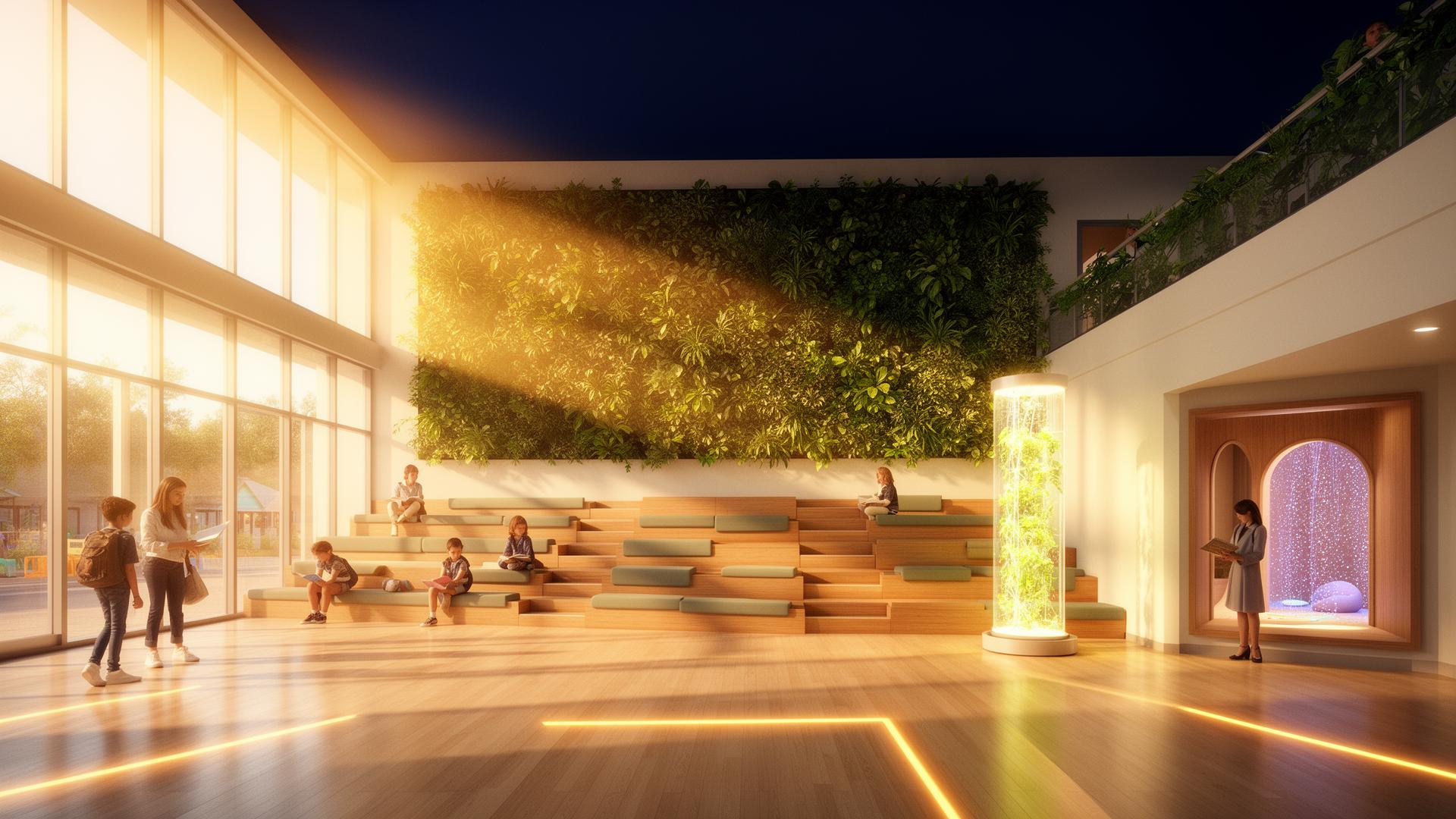
The Forum is the opposite of a cafeteria-lobby. A south-facing glass wall floods the room with morning light; the floor steps down in three tiers toward it, each one upholstered in warm bouclé so students can sit, sprawl, or lean against the wood-clad risers.
A two-story green wall climbs the back side of the room, woven with a vertical hydroponic tower so that the plants aren't decoration — they're curriculum. Off the main lounge, a small alcove holds a regulated sensory environment with bubble tubes and fiber-optic curtains for students who arrive needing to settle.
There are no announcements. The only screen is a quiet wayfinding panel running today's schedule in light gray type. The whole space is calibrated to one job: make the first ten minutes feel safe.
Floor-to-ceiling daylight, green wall, soft warm woods, almost no signage.
Acoustic treatment damps everything to a library-quiet hush.
Bouclé tiers, warm felt, smooth river stones along the planter edge.
Living plant wall, faint citrus from cleaning protocol.
A day in the space
7:30 AM
Soft landing
Students filter into the tiers; advisors do warm check-ins in the soft-seating clusters.
7:45 AM
Regulation zone
Sensory alcove hosts students who need a slower start — no stigma, no sign-in.
8:00 AM
Gentle transition
Lighting shifts a few hundred kelvin warmer; the quiet schedule panel highlights first period.
Free periods
Day-long retreat
Focus booths and the Daylight Lounge stay open as a campus-wide regulation resource.
Built with real product
Click any card to open full specs.
Backed by research
Peer-reviewed studies, federal reports, and major meta-analyses that back the design choices and claims above.
4 sources
Daylight in classrooms correlates with faster learning in reading and math.
Students in classrooms with the most daylight progressed 20% faster in math and 26% faster in reading over one year.
Heschong Mahone Group (1999, updated 2003). Daylighting in Schools: An Investigation into the Relationship Between Daylighting and Human Performance. California Energy Commission.
View source ↗Biophilic design lowers cortisol and supports emotional regulation in students.
Visual connection with nature and presence of water/plants lower stress hormones and blood pressure.
Browning, W. D., Ryan, C. O., & Clancy, J. O. (2014). 14 Patterns of Biophilic Design. Terrapin Bright Green.
View source ↗Sensory-regulation rooms reduce challenging behaviors and time-out-of-class.
Multi-sensory environments produced measurable improvements in attention and self-regulation across multiple studies.
McManus, S., & Carey, M. (2021). The effectiveness of multi-sensory environments for children with autism: a systematic review. Review Journal of Autism and Developmental Disorders, 8, 357–375.
View source ↗Trauma-informed and 'soft start' arrival routines improve school-day readiness.
Structured calm-arrival practices significantly reduce dysregulation incidents in the first hour of school.
Brunzell, T., Stokes, H., & Waters, L. (2016). Trauma-informed positive education: Using positive psychology to strengthen vulnerable students. Contemporary School Psychology, 20, 63–83.
View source ↗Citations are provided for verification and further reading. Inclusion does not imply endorsement of any specific product by the cited researchers or institutions.

Curiosity spark + 'what could I build today?'
Walk in and see something being made.
Walk-through · what the space feels like
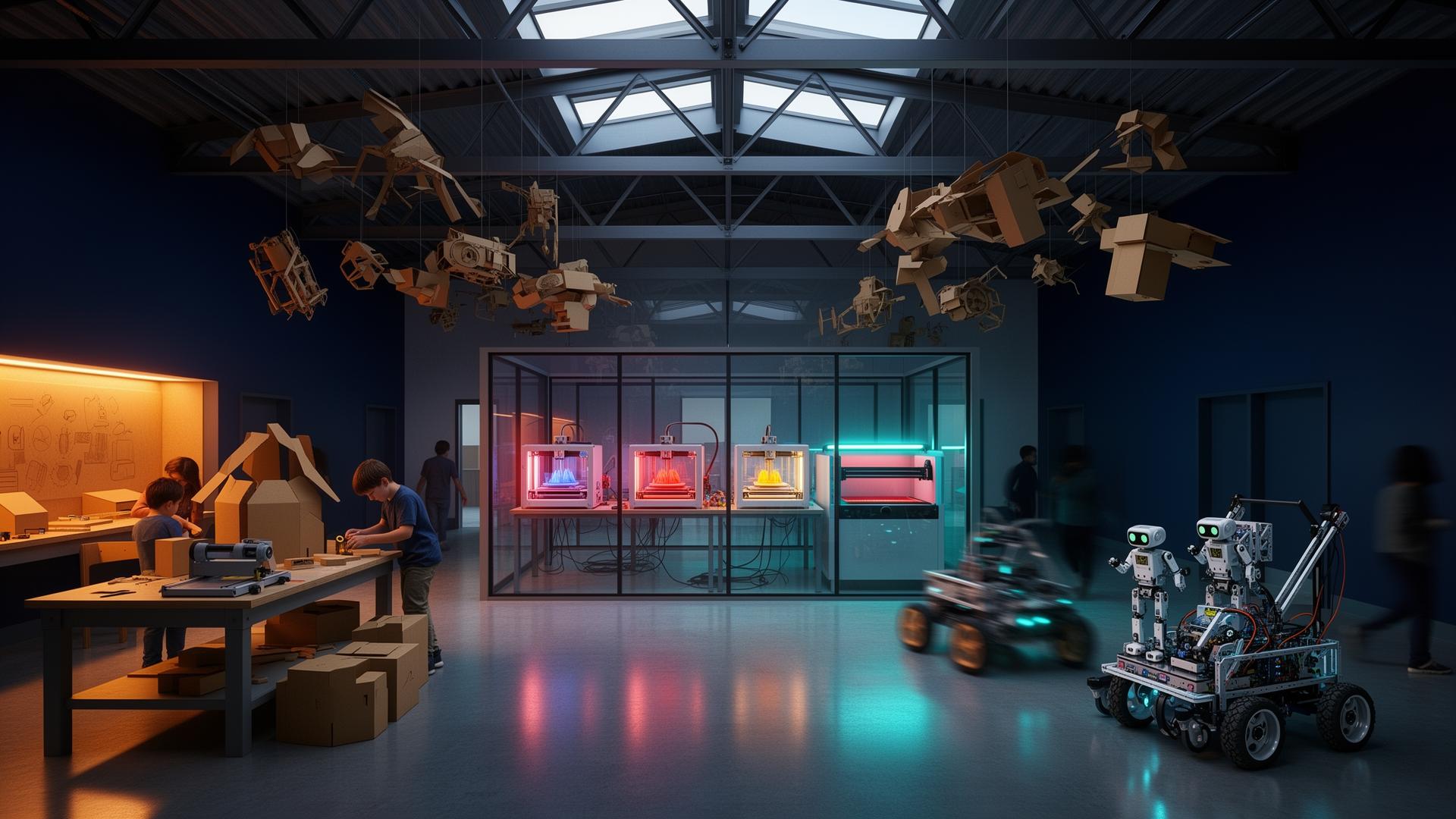
The Atrium is engineered around one truth: kids are curious when they see other kids making things. The arrival space is dominated by a glass-walled fabrication bay — a print farm of Bambu Lab printers humming, a desktop laser cutter etching a sign, a maker bench at student height where last-period kids are still finishing yesterday's prototypes.
Overhead, a rotating skyline of student-built cardboard sculptures hangs from the trusses — a literal exhibit of the previous month's work. A robotics cart rolls slow laps through the commons, student-programmed robots roaming as ambient inspiration.
Drop-in bins of Strawbees and Makey Makey live at the perimeter — a five-minute window between bells is enough to start a build. The space telegraphs one message before the first bell rings: making is what we do here.
Glass-walled print farm glowing, laser-cutter sparks, suspended cardboard skyline.
Soft whine of stepper motors, a ChompSaw cutting cardboard, robots beeping.
Raw plywood benches, freshly printed PLA still warm, corrugated cardboard.
Faint warm-plastic from the printers, cut cardboard, a hint of solder.
A day in the space
7:40 AM
Yesterday's prints, today's hands
Overnight prints are pulled from the bed and handed to the students who designed them.
7:55 AM
Build sprint
Five-minute Strawbees challenges run between bells; winners get displayed on the LED rail.
Lunch
Open shop
The fabrication bay opens to drop-in projects with a maker-in-residence on duty.
After school
Robotics & climate club
Forward Education sustainability kits anchor an open-build window every afternoon.
Built with real product
Click any card to open full specs.
Backed by research
Peer-reviewed studies, federal reports, and major meta-analyses that back the design choices and claims above.
4 sources
Maker- and tinkering-based learning increases STEM engagement and identity.
Making practices broaden participation in STEM, especially for students historically underrepresented.
Vossoughi, S., & Bevan, B. (2014). Making and Tinkering: A Review of the Literature. National Research Council Committee on Out of School Time STEM.
View source ↗Visible making (glass-walled fabrication) builds curiosity and STEM identity in passers-by.
Public, observable making supports learning even for students who never directly participate.
Sheridan, K. M., Halverson, E. R., Litts, B. K., et al. (2014). Learning in the making: A comparative case study of three makerspaces. Harvard Educational Review, 84(4), 505–531.
View source ↗Short, frequent build challenges drive computational and creative confidence more than one-off projects.
Iterative 'projects-passion-peers-play' loops outperform single-shot projects for creative skill development.
Resnick, M. (2017). Lifelong Kindergarten: Cultivating Creativity through Projects, Passion, Peers, and Play. MIT Press.
View source ↗Early access to robotics improves computational thinking in young children.
K-2 students using programmable robots showed significant gains in sequencing, debugging, and CT concepts.
Bers, M. U., Flannery, L., Kazakoff, E. R., & Sullivan, A. (2014). Computational thinking and tinkering: Exploration of an early childhood robotics curriculum. Computers & Education, 72, 145–157.
View source ↗Citations are provided for verification and further reading. Inclusion does not imply endorsement of any specific product by the cited researchers or institutions.

Student voice + agency.
Students as the voice of the building.
Walk-through · what the space feels like
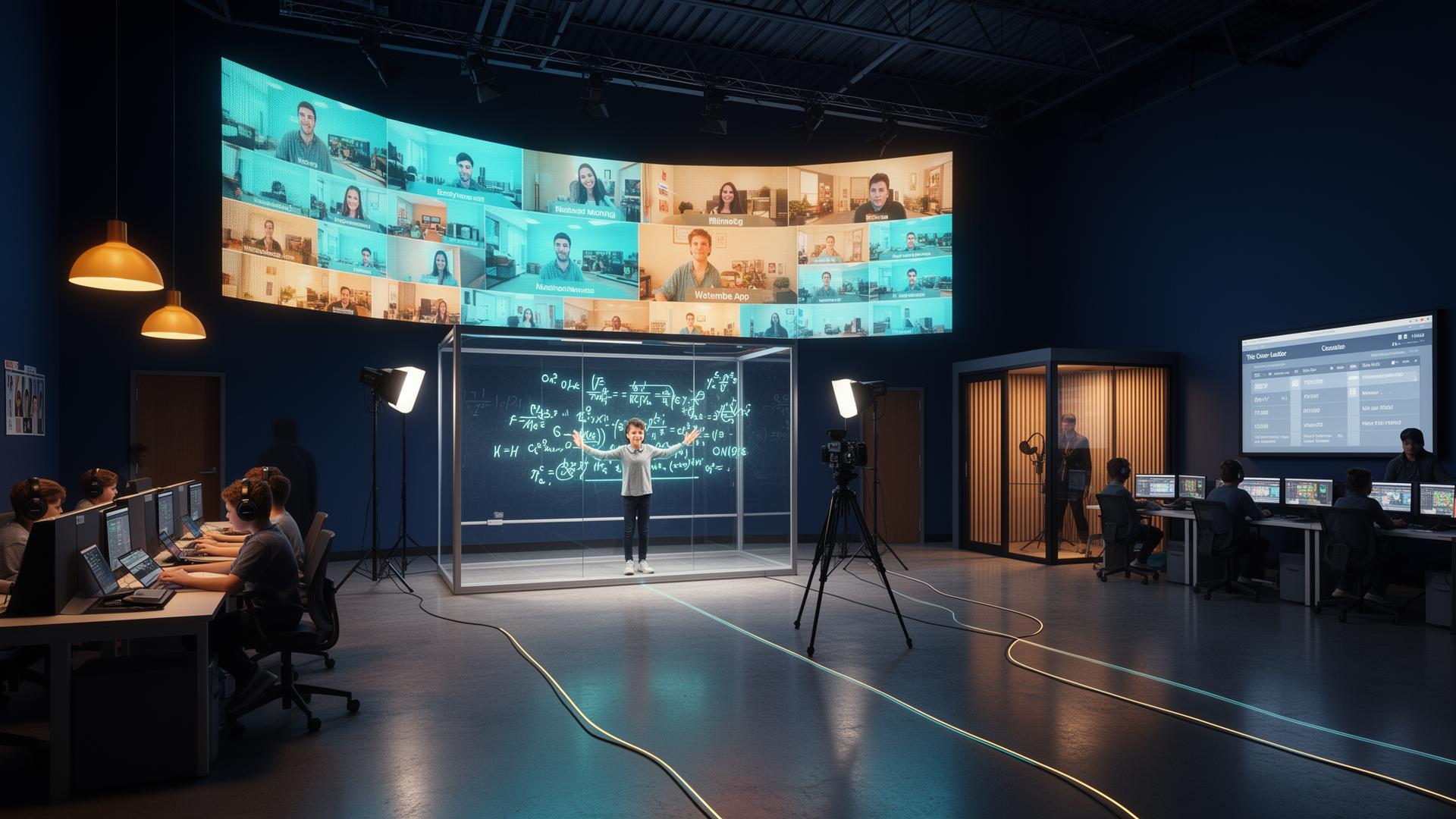
The Newsroom treats students as broadcasters from the moment they arrive. A glass lightboard studio sits at the heart of the room, lit like a TV set; a curved Clear Touch display behind it carries the live broadcast, so the room watches itself in real time.
Along the wall, an edit bay of dual-monitor Lenovo workstations is already in motion: 7th-grade producers cutting tomorrow's segment, an 11th-grade podcaster setting up in an acoustic booth, two 4th-graders feeding hand-drawn Animatic frames into the morning show.
Mobile editorial desks let the room reconfigure around the story of the day. An immersive audience pod tucks into the corner for premiering student documentaries. This isn't a media class — it's a daily ritual where the building hears from itself.
Studio lighting on a glass lightboard, curved LED feed, on-air red light glowing.
Live mic'd hosts, padded-booth quiet during recording, soft headphone bleed at edit bays.
Cool glass lightboard, leather host stools, brushed metal control desks.
Coffee from the producer's cart, faint warm-electronics from the studio rig.
A day in the space
7:30 AM
Show prep
Producer team finalizes the run-of-show; edit bays push final cuts to the broadcast rig.
7:55 AM
Live show
Morning broadcast goes live on the LED feed and pushes to every classroom display.
Mid-day
Podcast booth
Acoustic Corbett booths host one-on-one student interviews and reflection podcasts.
Weekly
Doc premiere
Immersive pod hosts long-form student documentary screenings open to the whole building.
Built with real product
Click any card to open full specs.
Backed by research
Peer-reviewed studies, federal reports, and major meta-analyses that back the design choices and claims above.
3 sources
Student-produced media improves literacy, voice, and civic engagement.
Production-based media literacy increases critical thinking, writing quality, and civic participation.
Hobbs, R. (2017). Create to Learn: Introduction to Digital Literacy. Wiley-Blackwell.
Digital storytelling improves writing outcomes and engagement across grade levels.
Students producing digital stories show gains in writing, research, organization, and tech fluency simultaneously.
Robin, B. R. (2008). Digital storytelling: A powerful technology tool for the 21st century classroom. Theory Into Practice, 47(3), 220–228.
View source ↗Authentic audience (broadcasting to peers/community) raises quality of student work.
Real audiences increase revision behavior and writing quality more than teacher-only audiences.
Magnifico, A. M. (2010). Writing for whom? Cognition, motivation, and a writer's audience. Educational Psychologist, 45(3), 167–184.
View source ↗Citations are provided for verification and further reading. Inclusion does not imply endorsement of any specific product by the cited researchers or institutions.

Visible learning + cross-cohort inspiration.
Every classroom is a window onto learning next door.
Walk-through · what the space feels like
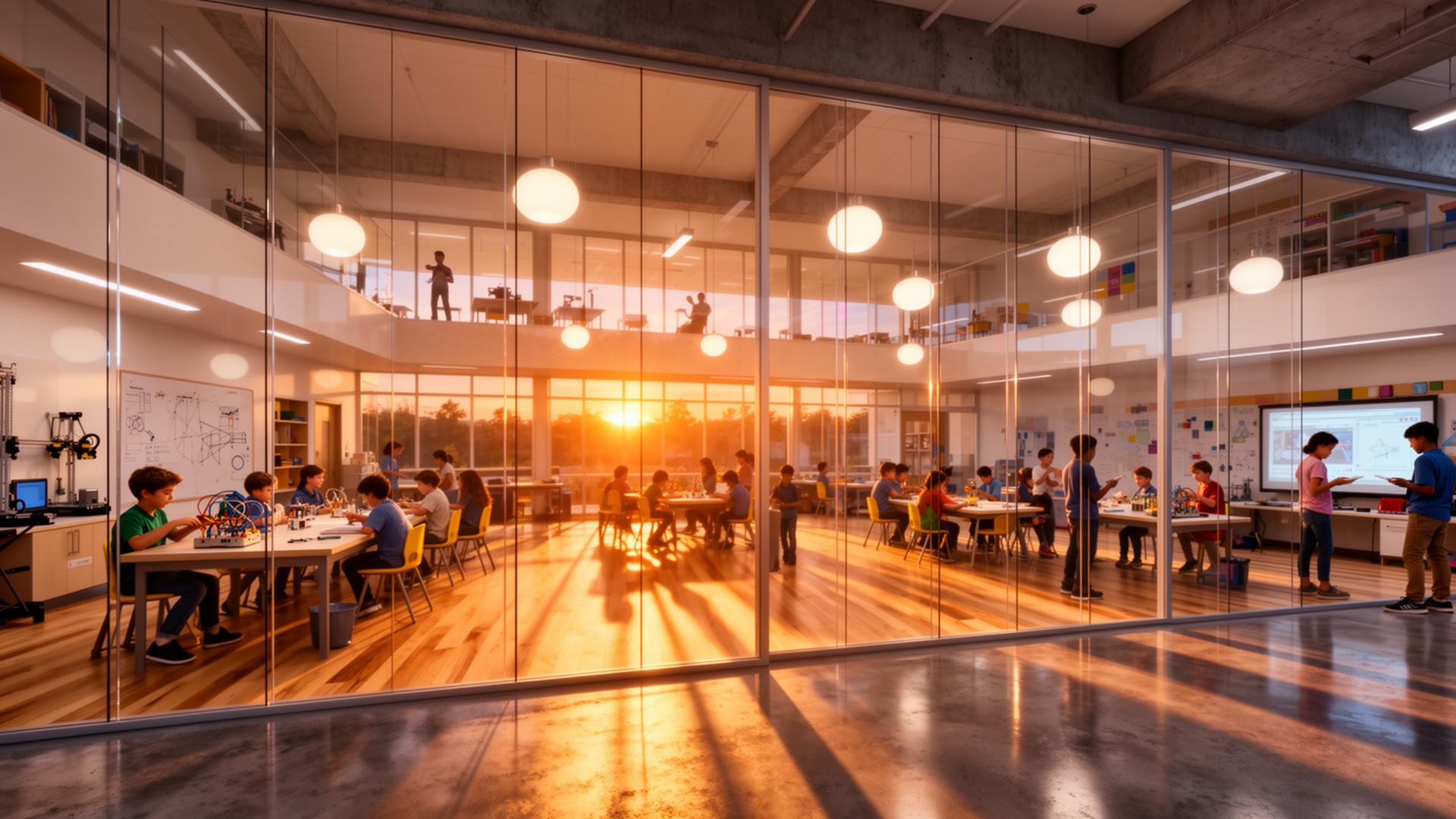
The Studio Loft is a single open volume sliced into four working studios by floor-to-ceiling frameless glass walls. There are no dark corridors, no closed doors hiding 'the smart kids' room. A 3rd-grade ecology build, a 6th-grade robotics sprint, an 11th-grade design crit, and a teacher PD session are all happening shoulder to shoulder — visually connected, acoustically separate.
The glass walls are demountable. When the 3rd-grade ecology unit grows into a cross-grade exhibition, the wall between two studios slides out by Friday afternoon and the cohorts share one room by Monday. The shell of the building never changes; the rooms change every term.
Polished concrete underfoot, warm oak floors inside each studio, soft pendant lighting overhead. Golden afternoon light rakes through the glass and reaches every desk — even the inboard ones — because nothing solid is in the way.
Frameless glass walls, four simultaneous studios visible at once, raking sunset light through the whole loft.
Acoustic glass + targeted absorption keeps each studio at conversation volume; no bleed between rooms.
Cool tempered glass, warm oak floors inside each studio, brushed-metal door pulls.
Warm PLA from a print station, fresh-cut basswood from a model shop.
A day in the space
8:15 AM
Parallel starts
Four studios kick off simultaneously — younger students see older students at work through the glass.
10:30 AM
Cross-cohort crit
A glass wall slides open; two studios merge for a 20-minute peer-review session.
1:00 PM
Studio reset
Mobile worksurfaces roll out to the loft for an interdisciplinary project sprint.
End of term
Wing reconfigure
Demountable walls relocate over a weekend to match next semester's cohort sizes — no construction.
Built with real product
Click any card to open full specs.
Backed by research
Peer-reviewed studies, federal reports, and major meta-analyses that back the design choices and claims above.
3 sources
Visible learning across cohorts increases motivation and peer modeling.
Making learning visible — to students and across classrooms — has one of the largest documented effect sizes (d > 0.40) on achievement.
Hattie, J. (2009). Visible Learning: A Synthesis of Over 800 Meta-Analyses Relating to Achievement. Routledge.
Flexible, reconfigurable space is one of the strongest physical predictors of learning gains.
Flexibility was identified as one of seven physical design parameters driving the 16% learning-progress variation.
Barrett, P., Davies, F., Zhang, Y., & Barrett, L. (2015). Clever Classrooms: Summary report of the HEAD Project. University of Salford.
View source ↗Acoustic separation is essential when classrooms are visually open.
Background noise > 35 dBA measurably reduces speech intelligibility and comprehension, especially for younger learners and ELLs.
American National Standards Institute (2010). ANSI/ASA S12.60-2010 Part 1: Acoustical Performance Criteria, Design Requirements, and Guidelines for Schools.
View source ↗Citations are provided for verification and further reading. Inclusion does not imply endorsement of any specific product by the cited researchers or institutions.

Mental health + restorative + identity.
A real place — not a converted closet — for every student to feel safe.
Walk-through · what the space feels like
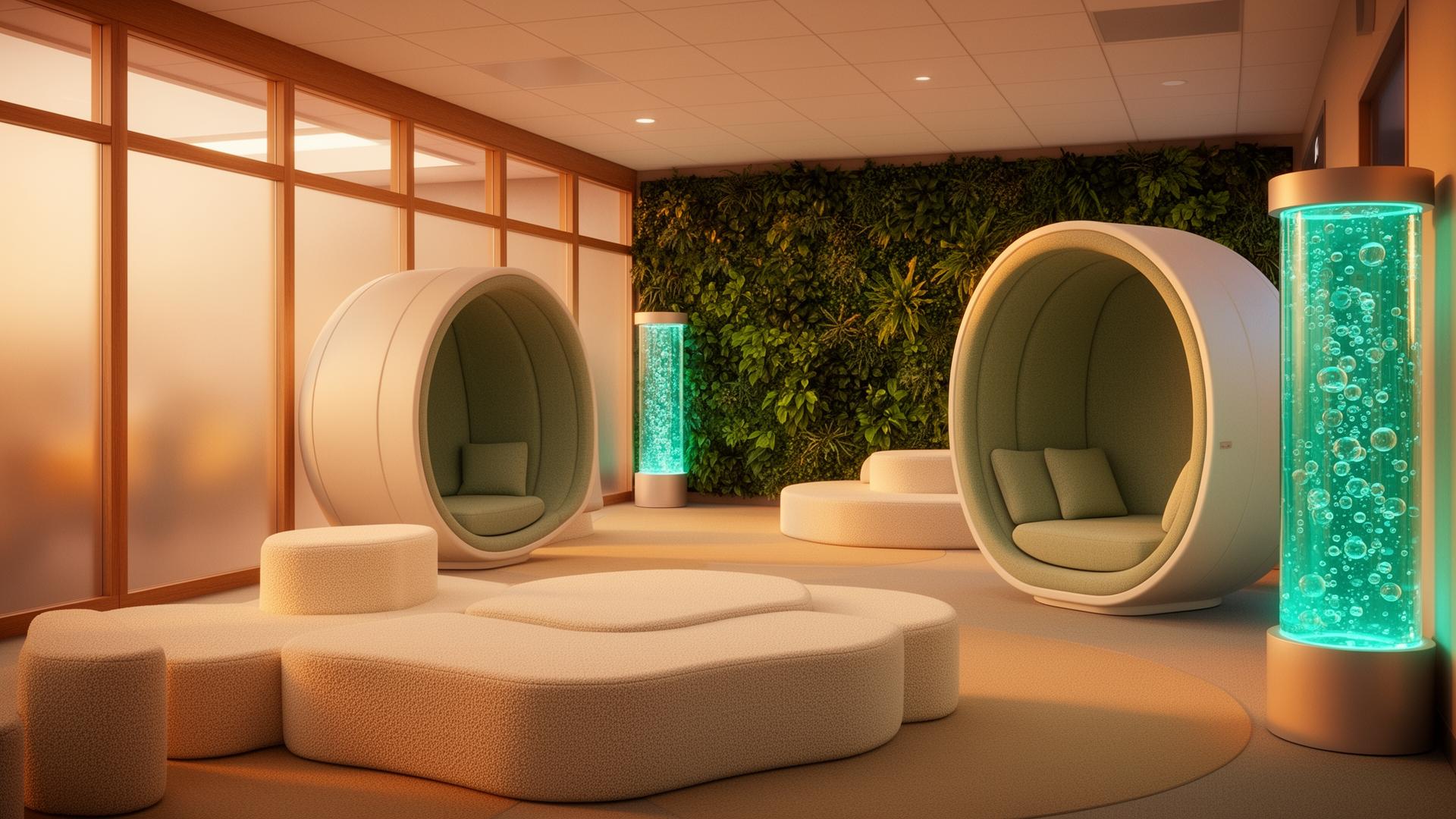
The Sanctuary is the answer to the question 'where do you go when you're not okay?' It's not a converted office. It's a designed space: warm lighting, a living plant wall, and a quiet cluster of freestanding acoustic pods scattered around a soft bouclé conversation pit.
Each pod has a job. One is a single-person retreat — slip inside, close the curtain, ride out a panic spike with bubble-tube light and silence. One is a two-seater for restorative conversations between a student and an advisor. One is a small-group pod for an affinity-group meeting or a peer-mentoring circle.
Framed-glass walls with frosted lower panels separate the sanctuary from the wellness counselor's office — privacy without isolation. The whole room is calibrated for nervous-system regulation: warm color temperature, sound dampening, biophilic accents, zero overhead announcements.
Curved acoustic pods, living plant wall, glowing bubble tubes, warm amber light wash.
Library-quiet baseline; pods isolate conversation completely.
Bouclé pods, soft felt panels, weighted lap blankets stocked in each pod.
Living wall + a soft cedar diffuser. No school-cleaning-product sting.
A day in the space
Anytime
Drop-in regulation
Any student can take 15 minutes in a single-person pod — no pass, no questions.
Daily
Restorative conversation
Two-seater pods host advisor / student check-ins out of public sightlines.
Weekly
Affinity & peer-mentor circles
Multi-user pods host identity-group meetings and peer-mentoring cohorts.
Crisis support
Wellness counselor adjacency
Frosted-glass framed wall connects sanctuary to counselor's office — visible support, private conversation.
Built with real product
Click any card to open full specs.
Backed by research
Peer-reviewed studies, federal reports, and major meta-analyses that back the design choices and claims above.
3 sources
Multi-sensory environments improve self-regulation for students with sensory-processing needs.
Student-controlled MSE sessions reduced anxiety and improved engagement compared to clinician-controlled sessions.
Unwin, K. L., Powell, G., & Jones, C. R. (2022). The use of multi-sensory environments with autistic children: Exploring the effect of having control of sensory changes. Autism, 26(6), 1379–1394.
View source ↗Quiet, low-stimulation retreat spaces reduce disciplinary referrals.
Schools with dedicated regulation spaces saw measurable drops in office discipline referrals after one year.
Sciuto, M., & Saylor, C. F. (2020). Calming Corners and Sensory Pathways: Trauma-Informed Strategies in Elementary Schools. Journal of School Counseling, 18(4).
Acoustically zoned, low-light environments support neurodiverse learners across diagnoses.
ASPECTSS framework (Acoustics, Spatial sequencing, Escape, Compartmentalization, Transition, Sensory zoning, Safety) is now an internationally referenced autism-design standard.
Mostafa, M. (2014). Architecture for autism: Autism ASPECTSS in school design. Archnet-IJAR, 8(1), 143–158.
View source ↗Citations are provided for verification and further reading. Inclusion does not imply endorsement of any specific product by the cited researchers or institutions.

Project-based learning + exhibition + cohort identity.
The building shape-shifts every six weeks around the work.
Walk-through · what the space feels like
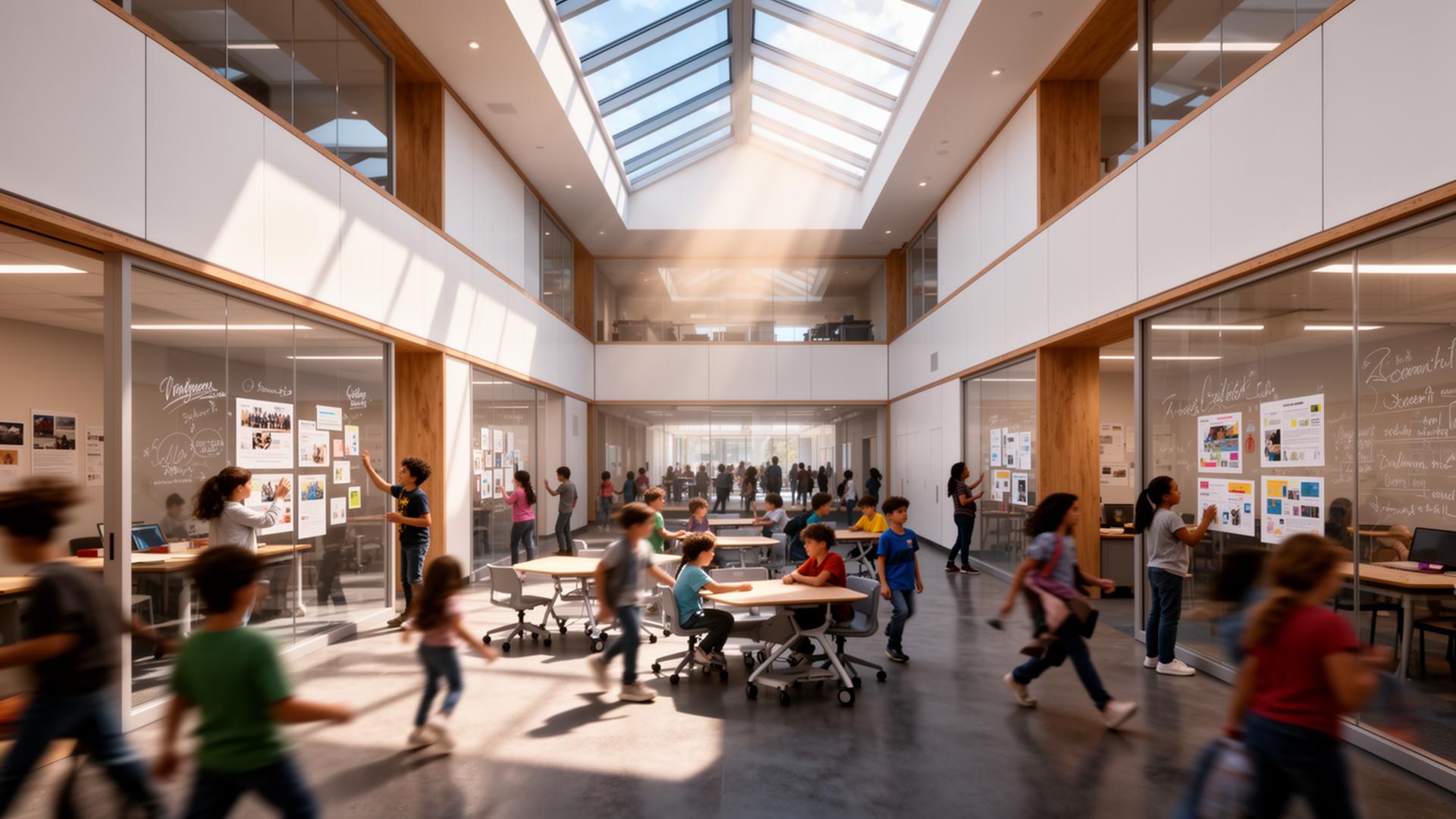
The Cohort Wing solves a problem most schools accept as permanent: the building locks in a floor plan in year one and the curriculum has to bend around it forever. Here, every interior wall is demountable. The wing reconfigures every six weeks around whatever the cohort is doing.
Today it's exhibition week. The middle three walls have been pulled and the wing is one long gallery: student work pinned to writable glass inserts, mobile worksurfaces lined up under a continuous skylight, parents and other cohorts streaming through. Next month it splits back into four advisory studios, each with its own cohort identity — color, finish, signage — using KI Genius's bold-finish wall panels.
There's no construction crew, no closed wing, no two-week disruption. Two facilities staff reconfigure the entire floor over a Saturday. The building literally learns from the cohorts using it.
Continuous skylight, white seamless walls with wood reveals, writable glass inserts covered in student work.
Lively in exhibition mode, library-calm in studio mode — same shell, different acoustic configuration.
Smooth seamless wall surfaces, warm wood reveals, dry-erase glass panels, brushed-metal furniture rails.
Print ink from exhibition prints, faint sawdust from a fresh wall reconfigure.
A day in the space
Studio weeks
Four cohort studios
Wing is divided into four advisory studios — each carrying its own identity via Genius finish wall panels.
Exhibition week
One long gallery
Interior walls retract — wing becomes a continuous public gallery for cohort showcase.
Project sprint
Two larger studios
Walls regroup into two big studios for cross-cohort project-based work.
Weekend reset
Two-person reconfigure
Facilities team relocates demountable walls in a single Saturday — no construction.
Built with real product
Click any card to open full specs.
Backed by research
Peer-reviewed studies, federal reports, and major meta-analyses that back the design choices and claims above.
3 sources
Reconfigurable, demountable walls let schools adapt to changing pedagogy without capital construction.
Schools with adaptable physical environments respond faster to changes in cohort size, program, and pedagogy.
OECD Centre for Effective Learning Environments (CELE). (2013). Innovative Learning Environments. OECD Publishing.
View source ↗Team-teaching and multi-cohort learning environments improve differentiation and outcomes.
Co-teaching across flexible spaces improved outcomes for students with and without disabilities.
Cook, L., & Friend, M. (2010). The state of the art of collaboration on behalf of students with disabilities. Journal of Educational and Psychological Consultation, 20(1), 1–8.
View source ↗Open, flexible plans require deliberate acoustic and visual design — not just removed walls.
Open plans without acoustic treatment harm speech perception; demountable acoustic walls solve this trade-off.
Mealings, K. T., Demuth, K., Buchholz, J. M., & Dillon, H. (2015). The effect of different open plan and enclosed classroom acoustic conditions on speech perception. Journal of the Acoustical Society of America, 138(4), 2458–2469.
View source ↗Citations are provided for verification and further reading. Inclusion does not imply endorsement of any specific product by the cited researchers or institutions.

High-density supply storage as a visible part of the maker culture.
The back-of-house that doubled the makerspace.
Walk-through · what the space feels like
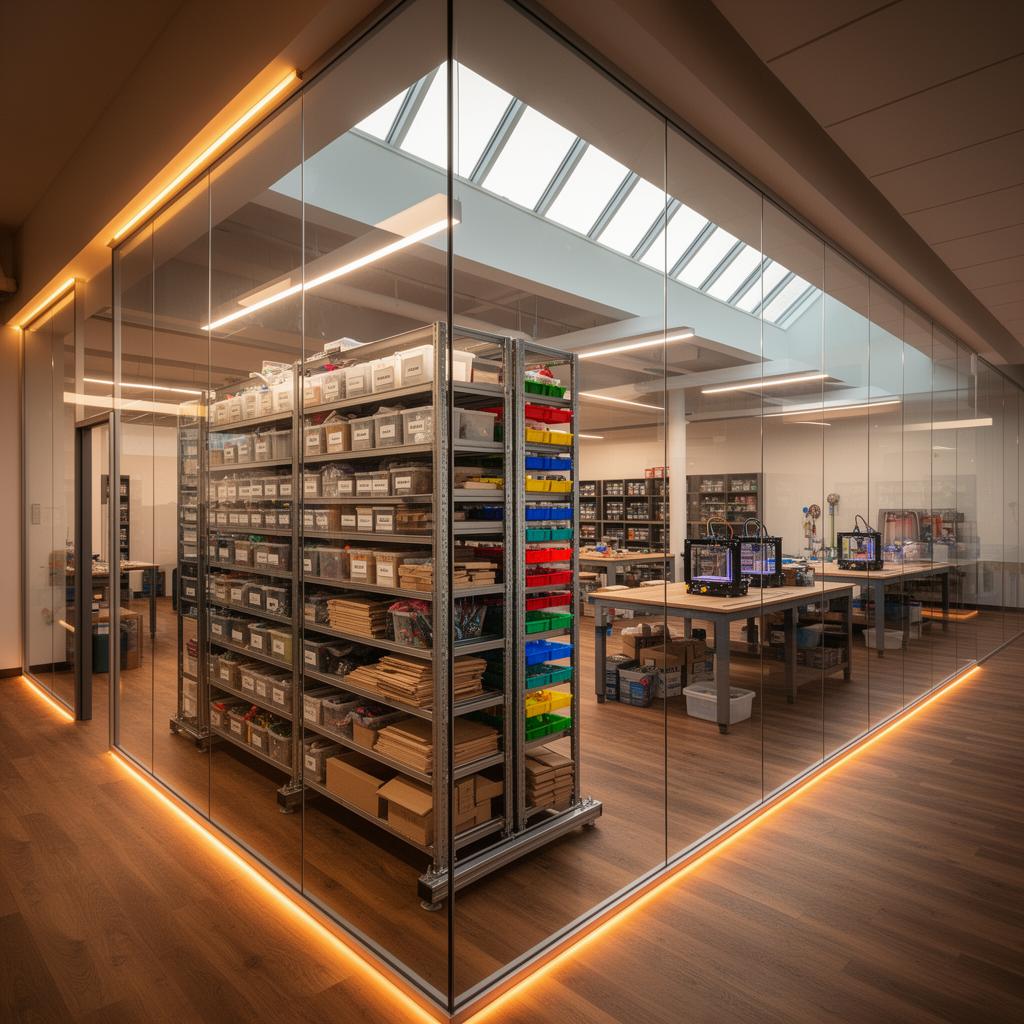
Every makerspace has the same dirty secret: half the floor is eaten by shelving. Filament, cardboard, electronics bins, half-finished projects, raw stock — all of it sprawling across what's supposed to be open making territory. The Maker Vault flips that.
Behind a frameless glass wall, an ActivRAC mobile shelving system from DSS condenses what used to be a 1,200 sq ft storage room into a single moving aisle. Every bin is labeled, color-coded by material family, and visible — kids press a button, the ranks glide open, they grab filament, the ranks close. The open making floor on the other side of the glass is now twice as large.
The vault isn't hidden. It's a feature. Students see the discipline of how a real shop runs — inventory, organization, materials science — every time they walk past. The mobile shelving is itself the lesson: space is a designed resource, not a given.
Color-coded bins behind glass, the slow choreography of ranks gliding on tracks, amber floor uplights.
The soft mechanical hum of the ActivRAC system, 3D printers humming in the adjacent shop.
Brushed-steel end panels, ergonomic powered-assist handles, smooth labeled bins.
Faint cardboard and PLA filament from the adjacent shop floor.
A day in the space
Morning prep
Material pull
Teacher and student aides open the vault, stage the day's project bins on the shop floor.
Class block
Self-serve resupply
Students open the ranks themselves to grab more filament or fasteners mid-project — no teacher gatekeeping.
Inventory day
Visible audit
Whole inventory is browsable behind glass — students help reorder and tag, learning supply-chain literacy.
After hours
Locked & lit
Ranks close, integrated lock engages, low amber accent stays on as a wayfinding glow.
Built with real product
Click any card to open full specs.
Backed by research
Peer-reviewed studies, federal reports, and major meta-analyses that back the design choices and claims above.
3 sources
High-density mobile shelving systems recover 50%+ of floor space versus fixed shelving.
K-12 case studies routinely document 50–66% reductions in storage footprint, releasing square footage for program use.
Spacesaver Corporation. (2021). High-Density Mobile Storage in Educational Facilities — Case Study Library.
View source ↗Tool and material access is a primary determinant of whether students follow through on maker projects.
Frictionless access to tools/materials is the single largest predictor of student project completion in makerspaces.
Halverson, E. R., & Sheridan, K. (2014). The maker movement in education. Harvard Educational Review, 84(4), 495–504.
View source ↗Just-in-time fabrication on-site (3D printing, laser cutting) raises iteration count and design quality.
On-site fabrication shortens design-build-test loops from weeks to hours, dramatically increasing iteration.
Blikstein, P. (2013). Digital Fabrication and 'Making' in Education: The Democratization of Invention. In FabLabs: Of Machines, Makers and Inventors. Transcript Publishers.
View source ↗Citations are provided for verification and further reading. Inclusion does not imply endorsement of any specific product by the cited researchers or institutions.

Storage as a varsity-grade prep and culture space.
Team gear, team identity, team room — one system.
Walk-through · what the space feels like
Most school equipment rooms are an apologetic afterthought — chain link, fluorescent buzz, gear piled to the ceiling. The Athletics Pavilion is the opposite: it's the most-photographed room in the building.
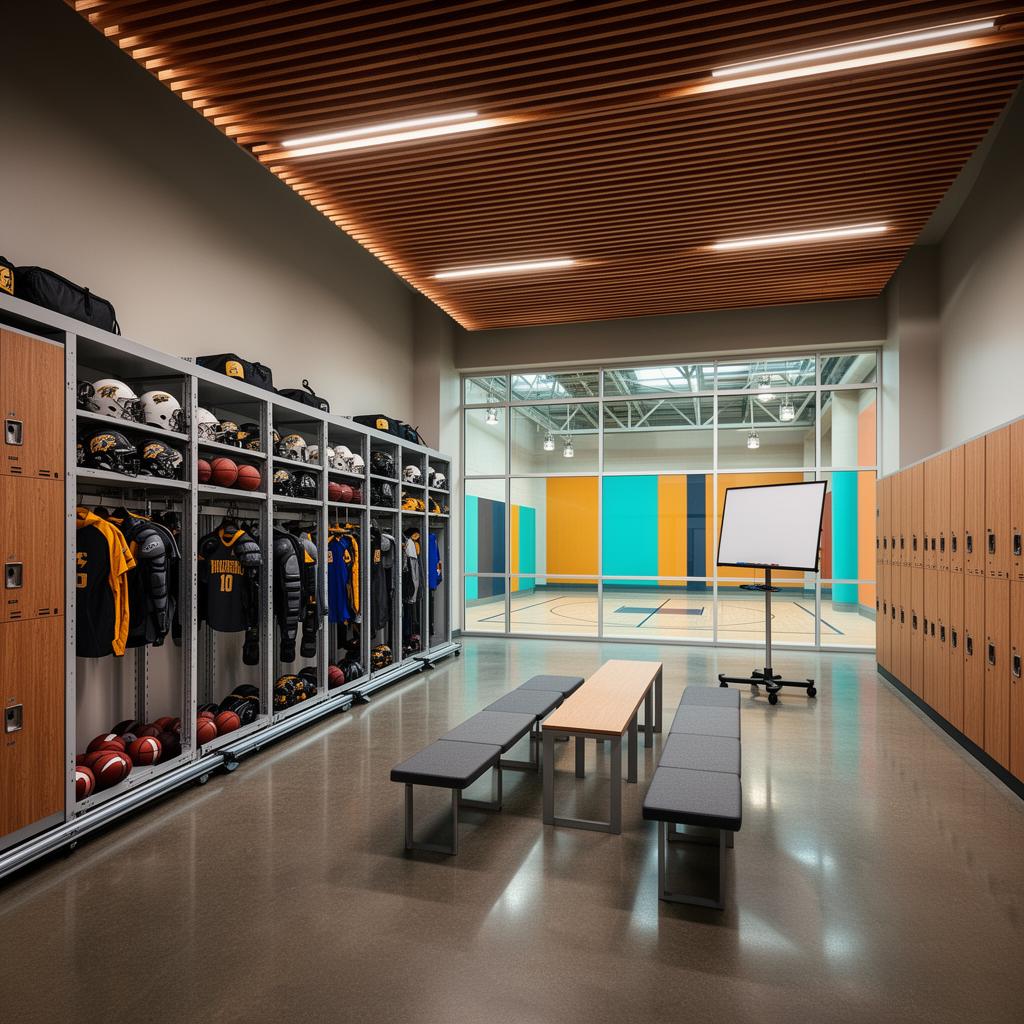
A long run of Spacesaver athletic mobile shelving from DSS spans one wall, end panels finished in school colors, powered Mobile Assist handles making the heaviest racks glide with one finger. Helmets, pads, uniforms, and balls are racked by sport and by athlete — every kid's gear has a known address.
Across the floor, a run of wood-front day-use lockers handles personal items. Soft acoustic benches and a height-adjustable coach's whiteboard cart turn the room into a pregame chalk-talk space. Through a glass wall the gym is visible — the pavilion is a threshold, not a closet.
School-color end panels, racked helmets in a clean grid, gym visible through glass.
Muted whir of the Mobile Assist powered handles, sneakers on the gym floor beyond.
Ergonomic spinner-grip handles, wood-front locker doors, soft bouclé team benches.
Fresh laundry from the uniform program, cedar from the locker wood, faint rubber from the basketballs.
A day in the space
Pregame
Gear pull
Athletes open the assigned ranks, grab full kits, suit up — no rummaging, no missing pads.
Chalk talk
Coach's huddle
Team gathers on the acoustic benches around the mobile whiteboard cart for the pregame walkthrough.
Postgame
Return & log
Gear goes back to its labeled position; equipment manager scans and audits in minutes, not hours.
Off-season
Multi-sport rotation
Ranks reconfigure for the next sport — football pads out, lacrosse in, same footprint.
Built with real product
Click any card to open full specs.
Backed by research
Peer-reviewed studies, federal reports, and major meta-analyses that back the design choices and claims above.
3 sources
Organized, dignified athletic facilities are linked to team retention and program identity.
Facility quality and locker-room culture are repeatedly cited as factors in middle/high school athletic participation.
Project Play / Aspen Institute. (2023). State of Play 2023: Trends and Developments in Youth Sports.
View source ↗Physical activity and athletic participation correlate with measurable academic gains.
Across 50+ studies, school-based physical activity positively impacted academic performance, attendance, and behavior.
CDC. (2010). The Association Between School-Based Physical Activity, Including Physical Education, and Academic Performance. U.S. Department of Health and Human Services.
View source ↗Mobile-assist powered storage reduces athletic-staff injury and load-handling risk.
Powered mobile-aisle systems require <2 lb of force to move 5,000+ lb of loaded shelving — well below NIOSH lifting thresholds.
Spacesaver Corporation / NIOSH ergonomic guidelines. (2019). Mobile Assist Ergonomic Performance Brief.
View source ↗Citations are provided for verification and further reading. Inclusion does not imply endorsement of any specific product by the cited researchers or institutions.

Curated archive + student-run museum + interactive history wall.
Where the school's memory becomes a public room.
Walk-through · what the space feels like
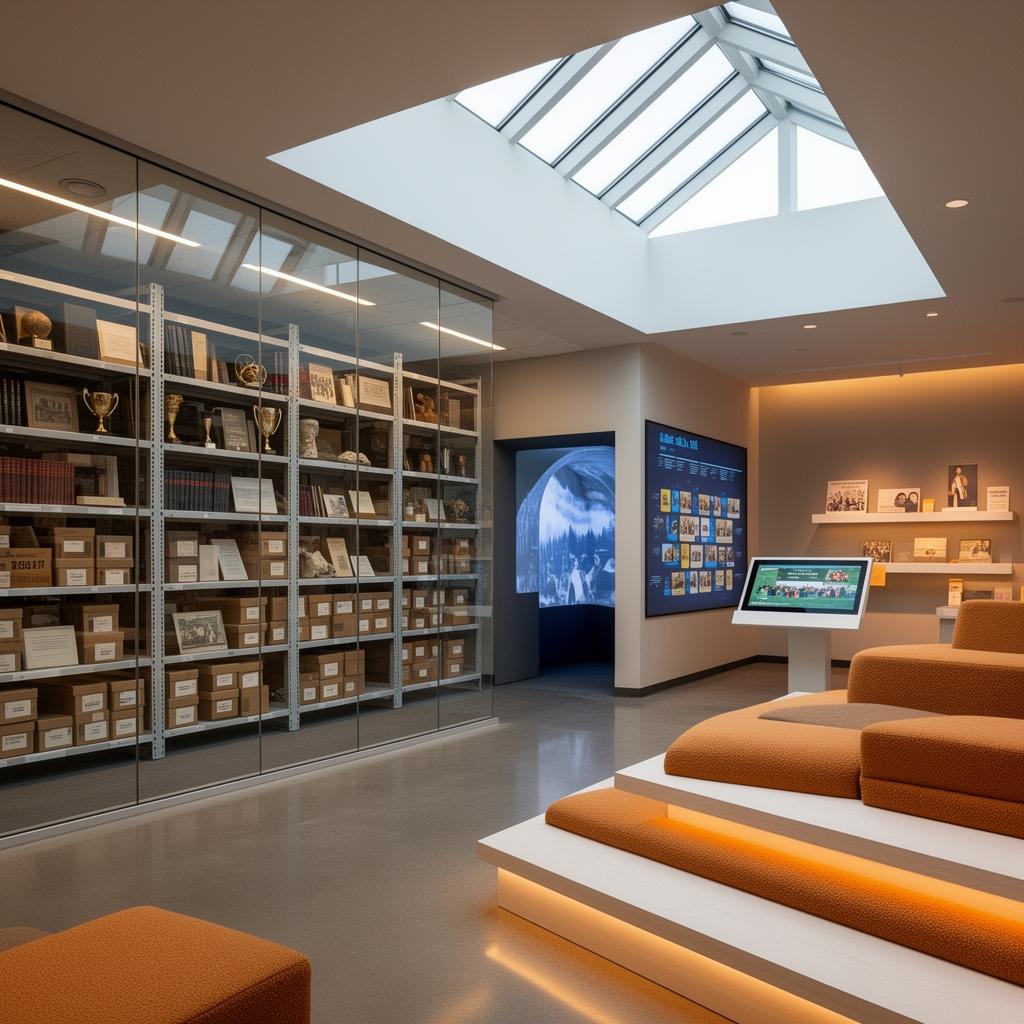
Every school has fifty years of trophies, yearbooks, photo collections, and donated artifacts shoved into a basement closet that no student has ever seen. The Living Archive drags all of it into the light — and turns curating it into a course.
Behind a frameless glass wall, a wing of museum-grade Spacesaver cabinets and high-density mobile shelving from DSS holds the school's full collection: yearbooks back to 1948, alumni donations, championship hardware, art-program archive boxes. Everything is preservation-grade, climate-aware, and visible.
Front-of-house, an interactive history wall lets students scroll a timeline of the school. A small immersive alcove plays oral-history interviews recorded by a student humanities cohort. Tiered lounge seating in warm bouclé makes the archive a hangout — a place memory is alive, not entombed.
Glass wall onto a museum-grade archive, glowing trophy shelf, scrolling timeline display.
Soft oral-history audio from the immersive alcove, low gallery acoustics.
Cool steel cabinet pulls, warm white-oak lounge tiers, smooth interactive glass.
Faint old-paper warmth from the yearbook bay, fresh linen from the new exhibit prints.
A day in the space
Daily
Public reading room
Open to any student during the school day — yearbooks pulled, oral-history clips played.
Curatorial period
Student curators at work
Humanities cohort accessions new donations, designs the next quarterly exhibit.
Alumni weekend
Reunion stage
Tiered seating becomes a reception space; cabinets open to feature each graduating decade.
History class
Primary-source lab
Classes pull real artifacts to do source work — not photocopies, the actual objects.
Built with real product
Click any card to open full specs.
Backed by research
Peer-reviewed studies, federal reports, and major meta-analyses that back the design choices and claims above.
3 sources
Student curation of school artifacts builds civic identity and historical thinking skills.
Hands-on archival and curatorial work develops the source-evaluation skills central to historical literacy.
Wineburg, S. (2018). Why Learn History (When It's Already on Your Phone). University of Chicago Press.
Museum-style learning environments in schools improve long-term retention.
Museum-style 'free-choice' learning contexts produce strong long-term knowledge retention and identity formation.
Falk, J. H., & Dierking, L. D. (2018). Learning from Museums (2nd ed.). Rowman & Littlefield.
Preservation-grade storage is required for long-term protection of yearbooks, trophies, art, and student archives.
NPS-standard archival cabinets and climate-aware shelving are the federal benchmark for institutional collections.
National Park Service. (2019). Museum Handbook, Part I: Museum Collections — Storage. U.S. Department of the Interior.
View source ↗Citations are provided for verification and further reading. Inclusion does not imply endorsement of any specific product by the cited researchers or institutions.
Raider-built scenarios · League of Innovative Schools · NAMM Best Communities for Music Education
The 3 scenarios below are not generic — each one is built around a real program, building, or recognition the district has already earned.

HS bio-tech research lab + public-facing open-house showcase.
A working bio lab — built around the SV Center for Biotechnology.
Walk-through · what the space feels like
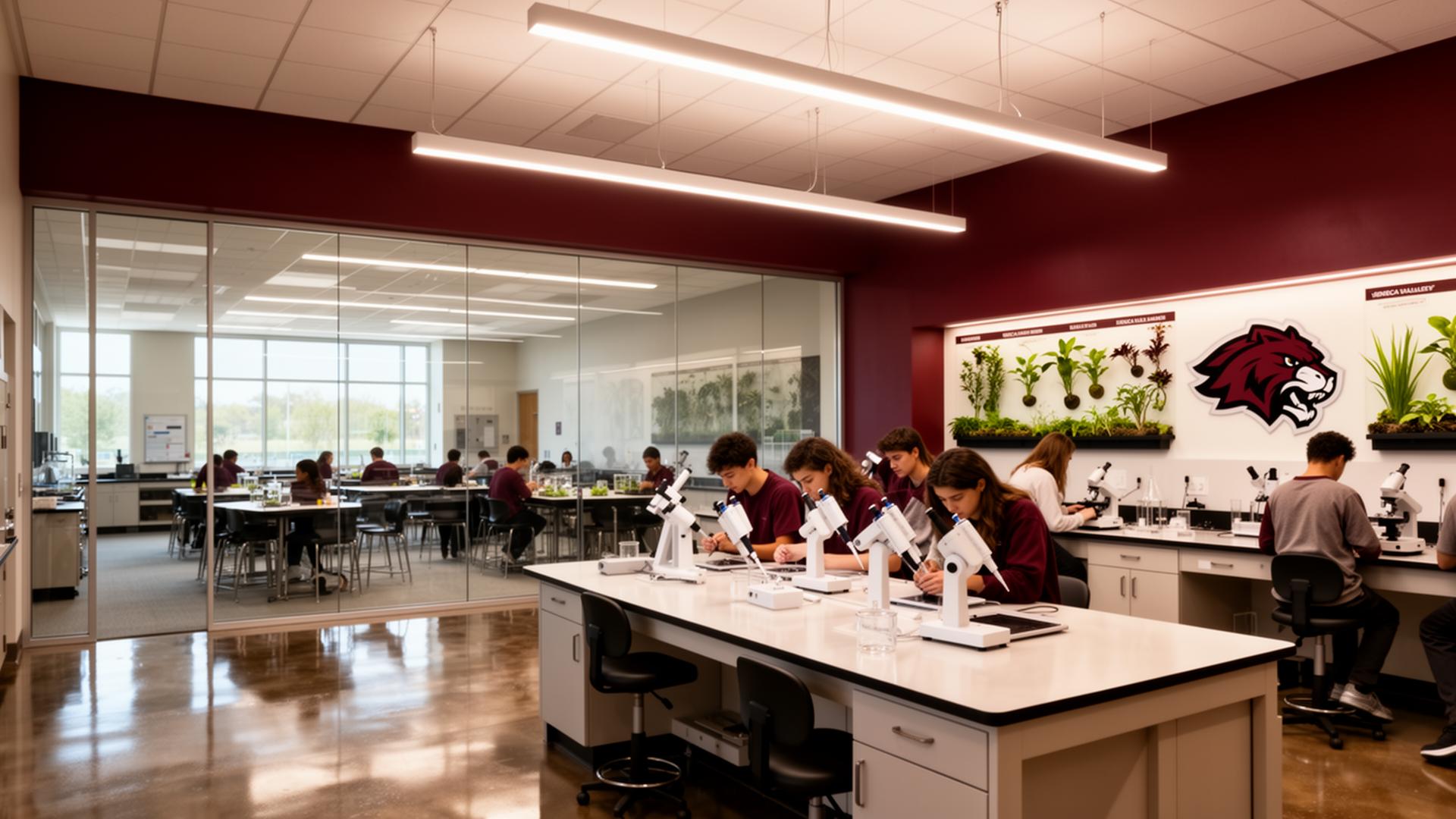
Seneca Valley already runs one of the strongest high-school biotech programs in western PA — the SV Center for Biotechnology open house drew classrooms, parents and partners around real student-led research. The Raider Biotechnology Lab is the next iteration of that program: a research environment that doubles as a recruiting tool for the district.
A run of KI Lightline frameless glass turns the lab into a visible asset from the SVHS corridor — every passing freshman sees seniors pipetting, running gels, and presenting at the data wall. Behind a Genius accent wall in Raider maroon, Spacesaver ActivRAC mobile shelving stores reagents, glassware, and PCR consumables in a fraction of the back-of-house footprint, so the lab floor stays open for benches and meeting space.
At the heart of the room, a Clear Touch panel runs as a shared data wall — students drop in microscope images, gel photos, and protocol drafts during lab. A Revolution Lightboard alcove makes science-communication first-class: every research project ends with a recorded explainer, ready for the next open-house night, the SV Annual Report, or a college application.
Frameless glass onto the corridor, maroon Genius accent wall, plant-bio living display under grow lights.
Soft hum of centrifuges, quiet hood fans, students workshopping a protocol at the data wall.
Cool epoxy bench tops, white pipette grips, the soft click of mobile shelving handles in the prep room.
Faint agar from the incubators, fresh basil and lettuce from the hydroponic wall — a working living lab.
A day in the space
Period 2
Bench science
Cohort runs PCR and gel electrophoresis; results post to the Clear Touch data wall in real time.
Lunch
Open lab
Independent-research students return to feed cell cultures and check the hydroponic system.
Period 7
Capstone seminar
Seniors present manuscripts on the data wall; classmates annotate live before recording the lightboard explainer.
Open House
Public showcase
Doors open to parents, board members and partners — the lab becomes the program's best recruiting tool.
Built with real product
Click any card to open full specs.
Backed by research
Peer-reviewed studies, federal reports, and major meta-analyses that back the design choices and claims above.
4 sources
Inquiry-based science instruction produces stronger conceptual understanding than traditional instruction.
Inquiry-based instruction consistently outperformed traditional methods across 138 studies.
Minner, D. D., Levy, A. J., & Century, J. (2010). Inquiry-based science instruction—what is it and does it matter? Results from a research synthesis years 1984 to 2002. Journal of Research in Science Teaching, 47(4), 474–496.
View source ↗Authentic lab experiences in high school predict STEM-major persistence in college.
Integrated, authentic lab experiences are tied to better mastery of science concepts and STEM identity.
National Research Council. (2006). America's Lab Report: Investigations in High School Science. National Academies Press.
View source ↗Transparent / glass-walled labs raise student aspiration and program visibility.
Visible advanced programs increase under-classmen enrollment intent for those programs.
American Institute of Architects Committee on Architecture for Education. (2019). Designing for Educational Excellence: Research-Informed Practice.
View source ↗Seneca Valley's biotech / authentic-research program is nationally recognized via the League of Innovative Schools.
SVSD's induction into the League recognizes district-wide commitment to research-informed, innovative practice.
Digital Promise. (2023). League of Innovative Schools — Seneca Valley School District profile.
View source ↗Citations are provided for verification and further reading. Inclusion does not imply endorsement of any specific product by the cited researchers or institutions.

Elementary great-hall + museum-style hands-on exhibit + Remake Learning stage.
Play with Purpose — a K-6 commons that learns like a children's museum.
Walk-through · what the space feels like
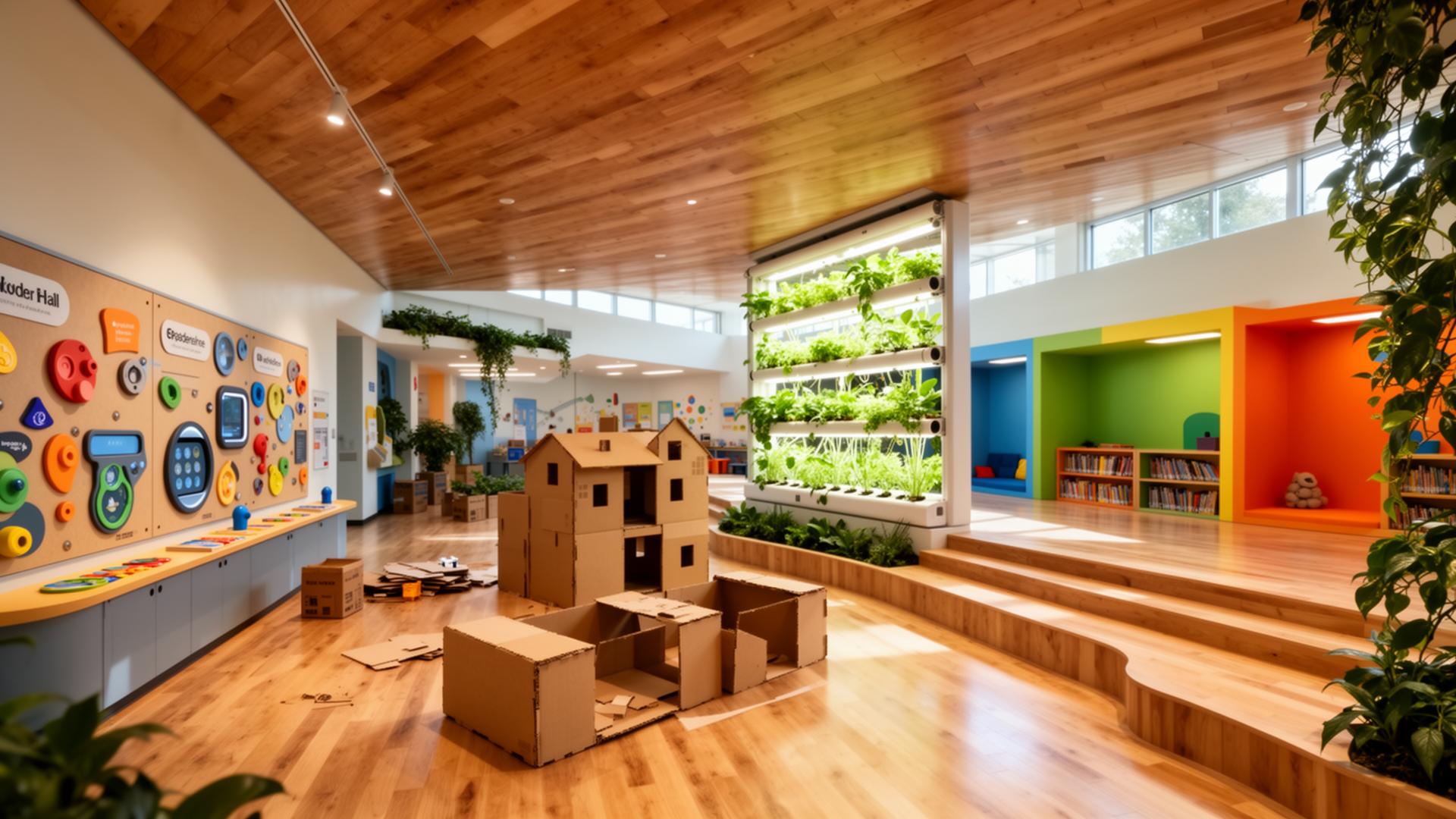
Ehrman Crest Elementary already broke ground nationally as the K-6 school designed in partnership with the Children's Museum of Pittsburgh — "Play with Purpose" is the district's own voice for it. The Wonder Hall extends that DNA into the building's central commons: a place where arrival, play, exhibit, and learning all share one room.
Down the long wall, an interactive Clear Touch wall and a Makey Makey tinkering bench let kindergartners poke a banana and trigger a sound; second graders build a cardboard-and-foil game controller. Across the floor, a Fork Farms vertical hydroponic tower glows green under the daylight — the same fresh basil ends up in the cafeteria.
A tiered Corbett Daylight reading bench climbs toward a clerestory window, doubling as morning-meeting seating for the whole grade. A Makedo cardboard-build corner stays half-finished on purpose — a city the kids extend each week. The whole space hosts the Remake Learning Days open house twice a year; the rest of the year, it's where school feels like a museum the kids belong to.
Warm wood ceiling, primary-color reading nooks, glowing hydroponic tower, a half-built cardboard city.
Kids triggering Makey-Makey sounds, quiet page-turns from the tiered bench, soft pump from the hydroponic.
Smooth interactive glass, corrugated cardboard edges, warm white-oak treads, soft bouclé nook cushions.
Fresh basil and lettuce from the Flex Farm, faint kraft paper from the Makedo corner.
A day in the space
Arrival
Wonder time
Kids land in the hall before homeroom — twenty minutes of free choice across the exhibits.
Morning meeting
Whole-grade gather
Tiered Daylight bench becomes amphitheater seating for the grade's morning meeting.
STEAM block
Rotations
Classes rotate through the Makey bench, the cardboard build, the hydroponic, and the touch wall — twenty minutes each.
Remake Learning Days
Public open house
Doors open to families and the Remake Learning network — kids run the exhibits themselves.
Built with real product
Click any card to open full specs.
Backed by research
Peer-reviewed studies, federal reports, and major meta-analyses that back the design choices and claims above.
4 sources
Children's-museum-style learning environments raise engagement, executive function, and family involvement.
Playful, exhibit-style environments drive deeper engagement and family co-learning than traditional classrooms for K-2.
Hopkins, E. J., & Weisberg, D. S. (2017). The youngest readers' dilemma: A review of children's learning from fictional sources. Developmental Review, 43, 48–70.
School–museum partnerships (the Ehrman Crest model) produce measurable gains in curiosity and persistence.
Ehrman Crest is the first U.S. public school co-designed with a children's museum; international recognition followed in its first year.
Children's Museum of Pittsburgh & Seneca Valley School District. (2022). Ehrman Crest Elementary and Middle School Design Case Study.
View source ↗Playful, hands-on coding/invention tools build early computational thinking.
Tangible, playful coding tools in K-2 close early gender and confidence gaps in computational thinking.
Sullivan, A., & Bers, M. U. (2018). The impact of teacher gender on girls' performance on programming tasks in early elementary school. Journal of Information Technology Education, 17, 153–162.
View source ↗School-based hydroponic systems improve produce consumption and science engagement.
Garden-based learning produced measurable academic and dietary improvements across reviewed studies.
Berezowitz, C. K., Bontrager Yoder, A. B., & Schoeller, D. A. (2015). School Gardens Enhance Academic Performance and Dietary Outcomes in Children. Journal of School Health, 85(8), 508–518.
View source ↗Citations are provided for verification and further reading. Inclusion does not imply endorsement of any specific product by the cited researchers or institutions.

Rehearsal hall + recording studio + livestream stage for SV's music program.
Built for an NAMM-recognized music program — perform, record, broadcast.
Walk-through · what the space feels like
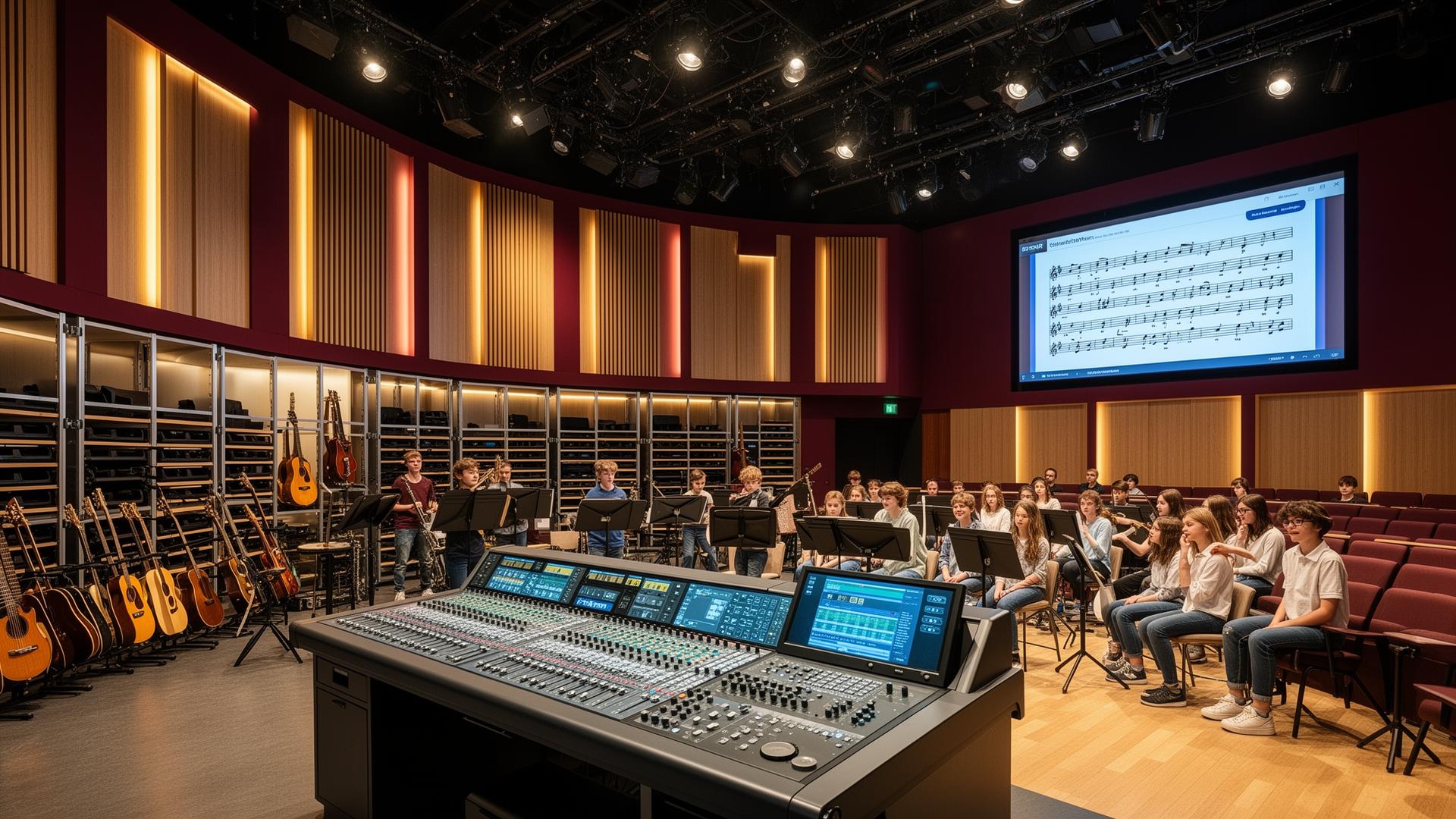
Seneca Valley is a NAMM Best Communities for Music Education district — and Ryan Gloyer Middle School's world-premiere of "Pillars of Gold" is the kind of moment most programs never get. The Raider Sound Stage is the room a program at that level deserves: rehearsal hall, recording studio, and broadcast stage in one footprint.
Along one curved wall, a custom Spacesaver mobile instrument-storage run from DSS finally solves the band-room problem — instrument lockers and uniform racks on powered Mobile Assist handles, finished in Raider maroon and gold, glide aside to open extra rehearsal floor when the full ensemble loads in. Across the room, a Corbett Daylight tiered audience platform lets parents, board members, and adjudicators watch a live rehearsal as a chamber audience.
At the front of the room, a Revolution Lightboard turns music-theory instruction into recorded explainers; a Clear Touch panel scrolls the score in real time, conductor-marked. KI Lightline glass between the stage and the adjacent control room makes the engineering side of music — mics, console, livestream — visible to every student in the room.
Curved acoustic wood paneling, maroon ceiling soffit, scrolling score on the front display, engineers visible through glass.
Tuned room acoustics — warm strings, clean brass, quiet conductor cues, no AC drone.
Wood instrument-cubby fronts, ergonomic spinner-grip handles on the storage ranks, soft bouclé audience tiers.
Valve oil, fresh rosin, a faint warm-wood smell from the new acoustic panels.
A day in the space
First period
Full-ensemble rehearsal
Storage ranks roll closed; the floor opens up for marching-band-sized formation rehearsal.
Mid-day
Sectionals & recording
Storage ranks split the room into small zones; sections rehearse in parallel and tracks get cut next door.
After school
World-premiere prep
Tiered audience platform fills with family and adjudicators; the room becomes a chamber-hall.
Livestream night
Concert broadcast
Adjacent control room livestreams the performance; lightboard pre-rolls run as the warm-up.
Built with real product
Click any card to open full specs.
Backed by research
Peer-reviewed studies, federal reports, and major meta-analyses that back the design choices and claims above.
4 sources
Music education is associated with measurable cognitive, social, and academic gains.
Students in music programs scored measurably higher in math, science, and English — controlling for prior achievement and demographics.
Guhn, M., Emerson, S. D., & Gouzouasis, P. (2020). A population-level analysis of associations between school music participation and academic achievement. Journal of Educational Psychology, 112(2), 308–328.
View source ↗Seneca Valley is nationally recognized for sustained excellence in music education.
SVSD has been repeatedly named a Best Community for Music Education for district-wide commitment to access and program quality.
NAMM Foundation. (2024). Best Communities for Music Education designation — Seneca Valley School District.
View source ↗Rehearsal-room acoustics directly affect performance quality and hearing safety.
Untreated rehearsal rooms regularly exceed 95 dBA — well above NIOSH safe-exposure thresholds — making acoustic design a hearing-safety issue.
American National Standards Institute. (2010). ANSI/ASA S12.60-2010 Acoustical Performance Criteria for Schools, with NIOSH music-room recommendations.
View source ↗Live-streaming and recording of student performances expands audience and motivation.
Authentic-audience performance opportunities significantly raise practice motivation and self-concept.
Hallam, S. (2010). The power of music: Its impact on the intellectual, social and personal development of children and young people. International Journal of Music Education, 28(3), 269–289.
View source ↗Citations are provided for verification and further reading. Inclusion does not imply endorsement of any specific product by the cited researchers or institutions.
What this proves
Every scenario above is buildable today with products we already represent. The question for a district isn't "is this possible" — it's "which function should our learning environment take on?"
Built from real products via fluxspace.io, corbettinc.com & diversifiedss.com